
☀️

Cryptonews

How to Register on Gate.io: A Step-by-Step Guide for Crypto Traders

Introduction
Are you looking to dive into the world of cryptocurrency trading? Gate.io is one of the leading cryptocurrency exchanges, offering a wide range of digital assets, low trading fees, and advanced tools for both beginners and experienced traders. Registering on Gate.io is the first step to accessing this robust platform. In this comprehensive guide, we’ll walk you through the process of how to register on Gate.io, ensuring you can start trading Bitcoin, Ethereum, and other cryptocurrencies with ease. Let’s get started!

Why Choose Gate.io for Crypto Trading?
Before we dive into the registration process, let’s explore why Gate.io stands out among other crypto exchanges. Gate.io supports over 1,400 cryptocurrencies, provides a secure trading environment, and offers competitive fees starting as low as 0.2%. Additionally, with features like futures trading, staking, and a user-friendly interface, Gate.io is ideal for anyone interested in expanding their crypto portfolio. Whether you’re a newbie or a seasoned trader, learning how to register on Gate.io opens the door to these opportunities.

Step-by-Step Guide to Register on Gate.io
Follow these simple steps to create your Gate.io account and begin your cryptocurrency journey:

  • Step 1: Visit the Official Gate.io Website
    Open your browser and go to the official Gate.io website at https://www.gate.io. Ensure you’re on the legitimate site to avoid phishing scams. Look for the “https” and the official domain.
  • Step 2: Click on “Register”
    On the homepage, locate the “Register” button, typically found in the top-right corner. Clicking this will direct you to the registration page where you can sign up using your email or phone number.
  • Step 3: Fill in Your Details
    Email or Phone: Enter a valid email address or phone number to receive a verification code. Password: Create a strong password (at least 8 characters, including letters, numbers, and symbols) to secure your account. Referral Code (Optional): If you have a referral code (e.g., U1QXB1o), enter it to benefit from bonuses or reduced fees. This step is optional but can enhance your trading experience. Agree to the Terms of Service and Privacy Policy, then click “Next.”
  • Step 4: Verify Your Account
    Check your email or phone for a verification code sent by Gate.io. Enter the code on the registration page to verify your identity. Once verified, click “Submit” to complete the initial registration.
  • Step 5: Enable Two-Factor Authentication (2FA)
    For added security, Gate.io recommends enabling 2FA. Download an authenticator app (e.g., Google Authenticator) and scan the QR code provided. Input the 2FA code generated by the app to activate this feature. This step is crucial to protect your account from unauthorized access.
  • Step 6: Complete Identity Verification (KYC)
    To unlock full trading features (e.g., withdrawals), you’ll need to complete Know Your Customer (KYC) verification. Go to “Account” > “KYC” and upload a government-issued ID (e.g., passport or driver’s license) and a selfie. Approval typically takes a few hours, after which you can fully use Gate.io.

Tips for a Smooth Gate.io Registration
Use a Secure Connection: Always register on a secure, private network to protect your data. Keep Your Credentials Safe: Store your password and 2FA backup codes in a secure location. Check for Promotions: Gate.io often offers bonuses for new users. Look for welcome offers during registration.

Benefits of Registering on Gate.io
After successfully registering on Gate.io, you’ll gain access to: A diverse range of cryptocurrencies, including altcoins and DeFi tokens. Low trading fees and high liquidity for seamless transactions. Advanced trading options like margin trading and futures. 24/7 customer support to assist with any issues.

Common Issues and Solutions
Verification Code Not Received? Check your spam folder or resend the code after a few minutes. KYC Rejection? Ensure your documents are clear and meet Gate.io’s requirements. Login Problems? Double-check your credentials or reset your password via the “Forgot Password” link.

Conclusion
Registering on Gate.io is a straightforward process that opens up a world of cryptocurrency trading opportunities. By following this guide on how to register on Gate.io, you can set up your account securely and start exploring the platform’s features. Whether you’re interested in Bitcoin trading, Ethereum investments, or discovering new altcoins, Gate.io is a reliable choice. Sign up today using the referral link https://www.gate.io/signup/U1QXB1o?ref_type=102 to get started and enjoy exclusive benefits!

Meta Description
Learn how to register on Gate.io with this step-by-step guide. Start trading Bitcoin, Ethereum, and more on one of the best crypto exchanges with low fees and advanced features. Sign up now!

Изображение отсутствует

ICP and TON Dominate April Blockchain Speed Rankings with Highest TPS

podium main7
  • ICP and TON lead April with highest TPS, supported by fast block times and strong user activity.  
  • Solana, Near, and Avalanche show mid-tier performance, far behind top two in transaction speed.  
  • Ethereum and Bitcoin rank low in TPS, highlighting scalability gaps versus newer blockchains.

New blockchain performance data from Phoenix Group reveals that Internet Computer (ICP) and Toncoin (TON) achieved the highest average transactions per second (TPS) in April 2025, surpassing all other networks. The figures provide a detailed view of how leading blockchains are scaling in response to growing user activity and application demand, with clear disparities emerging in throughput capabilities.

According to the data, ICP led all networks with an average TPS of 4,800. TON followed closely with 4,300 TPS. These results place both blockchains well above their competitors regarding transaction throughput. The report attributes part of this efficiency to rapid block times: ICP averaged 480 milliseconds per block, while TON completed blocks in just 390 milliseconds.

Equally, the results showed a high level of user engagement in the TON case. This brought its active address count to 13.7 million in April, the highest among all the tracked blockchains. Solana, for instance, has 3 million active addresses, which is unsurprising as it barely makes it to the TPS list.

The high speed and activity levels on TON and ICP indicate that these networks are handling large-scale operations with consistency, likely enabled by optimized consensus protocols and infrastructure.

Significant Drop in Mid-Tier Performance

The TPS results indicated that the performing blockchains were at the top, while the remaining blockchains ranked below the top two. Regarding AATP, Solana performed the third best with 95.8 TPS, Near Protocol was second with 81.7 TPS, and Avalanche was third with 70.4 TPS. Both these networks have been trading in the decentralized application development and smart contract platforms, but their throughput indicates a huge disparity in the transaction rates.

Sui took second place in this regard, with a transaction per second ratio of 66.6, followed by Polygon, with a TPS of 50.4, and Arbitrum, with a TPS of 46.6. Both support multiple decentralized finance (DeFi) and Web3 environments; however, the data indicate that they are not even close to ICP and TON in terms of the number of transactions per second.
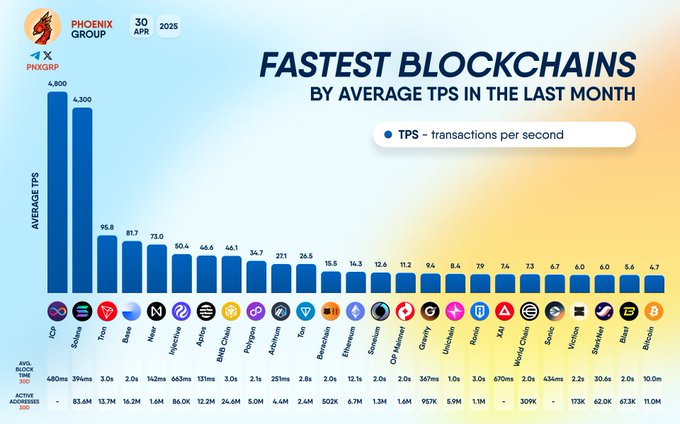
Fastest Blockchain By Avarage TPS Chart
Source: X

Notably, Ethereum, the second-largest blockchain based on market capitalization, has a TPS of only 3.5. This puts it considerably lower in the speed stakes than newer competitors. The penalty highlights that Ethereum continues to cope with its throughput bottleneck while moving toward scaling solutions like rollups.

Bitcoin, similarly, was among the lowest-ranked networks, with a reported TPS of 4.7. Though widely used as a store of value, its basic transaction throughput lags behind chains optimized for speed.

Tron, BNB Chain, and Cardano also posted moderate TPS values, indicating a more balanced trade-off between speed, security, and decentralization. While these chains did not experience a performance improvement metric enough to make the top ten list, they are still involved in other network developments.

The data available at Phoenix Group also entailed parameters other than TPS. Average block time and active addresses gave better insights into each network’s activity. These indicators indicate that TPS is a crucial causal indicator, but does not exist in isolation. Incorporating perspectives from TON and Solan, respectively, high-speed block times and active users put clamps on end-to-end speed across blockchain systems.


from Crypto News: Bitcoin, Ethereum & Price Data | BlockchainReporter https://ift.tt/s19xAwq
via IFTTT
Читать далее